The latest edition of Time has as its cover story the topic of bringing the Bible back into the public school curriculum. Good news right? Maybe. I've never been one to push for prayer in public schools and all that stuff. The ten commandments maybe, but in the secular sphere, I'm a little more comfortable with enforced pluralism, lest religious freedom for all be sacraficed on the altar of christian conservativism (here I'm thinking of a political movement more than a theological one).
The irony is that in a postmodern climate, (some may even argue post-postmodern) it appears that not all the vestiges of modernity have been eliminated in the public school system. The article contends that it would not be a violation of the separation of church and state iff (that's not a typo, but "if and only if" for those who may have forgotten stuff from their high school math classes) it is approached in complete neutrality. Sound good? Well beside the fact that most postmoderns have recognized what Bahnsen preached for years: namely, that such neutrality is a myth, there is more dissapointment ahead. The article further clarifys that by neutrality, it is intended that the Bible be approached as "an object of study, not God's received word" (p. 42). Oooops....there goes neutrality. Ironic, isn't it; scary even. The only thing more dangerous that presuppositions is blindness to your own.
Wednesday, March 28, 2007


Tuesday, March 20, 2007
McGrath Takes on Atheism
If you haven't seen this yet, it should be worth watching: Alister McGrath, Professor of Historical Theology at Oxford University, debating Peter Atkins, Professor of Chemistry at Oxford University, well-known atheist and supporter of Richard Dawkins. Dawkins has created quite a stir in recent popular media bringing back the glory days of secular atheism. It's ironic that his modernistic approach (leaning very much on logical positivism from the snippets I've read) gains a hearing in our current post-modern culture. Anyway, McGrath has been an outspoken critic for some time now and it should be interesting to see two Oxford boys going at it. I haven't watched the video yet, in fact I haven't been online much at all in the last week, so I apologize if there are any techincal difficulties, but you can stream or download the video here.
(HT: Justin Taylor)
(HT: Justin Taylor)
What's Become of Scotland?
For the last 5 - 10 years, maybe more, Aberdeen has been the place to do Biblical Studies, particularly at the Post Grad level. There NT department in recent years, in particular, has been one of their strong suits. Much discussion has taken place in the blogosphere in the last year or suggesting that Scotland was replacing the "Oxbridge" axis as the place to do biblical and theological studies, with leading scholars like Bauckham and Longenecker at St. Andrews, Hurtado at Edinburough and Marshall, Clarke, Watson, Gathercole and Williams at Aberdeen. Yet with Bauckham stepping down next year and the impending exodus from Aberdeen, things may be tilting bank towards cheery ole England. With Gathercole and Williams going to Cambridge and Watson heading to Durham, it will be interesting to see who the replacements are. In fact, Marshall is already an emeritus professor, so it is open to speculation as to how long it will be before he retires.
I'm always curious about the events that transpire behind the scenes of such transitions. If you haven't heard the story about how Grudem ended up leaving TEDS for Phoenix, you should listen to his audio interview at 9 Marks; it's fascinating...and probably not what you'd expect.
I'm always curious about the events that transpire behind the scenes of such transitions. If you haven't heard the story about how Grudem ended up leaving TEDS for Phoenix, you should listen to his audio interview at 9 Marks; it's fascinating...and probably not what you'd expect.
Friday, March 16, 2007
More Good Stuff from Nijay Gupta
I've already linked to a number of good resources from his blog and if you're considering post grad studies, you may as well make his blog one of your favorites. Nevertheless, for ease of my own access, I wanted to point out two more great posts, from a little ways back:
Suggestions for composing book reviews for publication here and here.
Suggestions for your thesis oral defense here.
Suggestions for composing book reviews for publication here and here.
Suggestions for your thesis oral defense here.
It's Here!
For those who haven't seen it, Bock's commentary on Acts in the BECNT series is available on Amazon. A major exegetical commentary on Luke and now Acts...wow...that's hardcore.
Tuesday, March 13, 2007
Branding Jesus
No, this isn't another post on tattoos. Branding is something anyone involved in the business world is probably all too familiar with. HSBC is in the midst of a huge branding push, especially here in the US. "Leveraging the brand" is basically making sure that customers get excellent service and (more importantly) know who they're getting it from. It's remarkable to think of just how valuable various brands are: Nike, Coca Cola, Starbucks, etc. The primary thing that makes a brand valuable is the reflex association that comes to mind when someone is confronted with the brand; good association=valuable brand, bad association=worthless brand. Example: Starbucks can get away with charging $5 for a cup of coffee because of what that coffee represents: 1) a great cup of coffee 2) a comfortable atmosphere where you can hang out as long as you like 3) a free drink if yours doesn't come out right or even if you just don't like it 4) a cup that looks so cool, most other coffee shops imitate them. Starbucks is basically selling a lifestyle...and doing very well at it.
What does all that have to do with Jesus? Well besides the obvious fact that Jesus, being perfect, probably would have drank Starbucks, there is a parallel for Christians seeking to practice acts of kindness and mercy in Jesus' name. In card services, part of our problem is that the portfolios we carry have different names. We don't want people thinking they're talking to GM when they rave about their customer service to their friends...we want them to know it's HSBC they just spoke with....the world's local bank (sorry, reflex). Yet, the challenge is communicating that without sounding hokie. Here's what I'm driving at: how do you give a cup of cold water in His name without people thinking you're doing it just to be a nice guy? Or even worse, without saying, "I'm doing this because Jesus wants me to" or the like, and sounding like you're only doing it for divine brownie points. My question grows out of a concrete situation - wanting to extend the love of Christ to an unbelieving co-worker. The co-worker is very aware that I'm a believer, but somehow that doesn't seem like enough (t0 me). I want them to comprehend that it is the "love of Christ that constrains me." Any suggestions?
What does all that have to do with Jesus? Well besides the obvious fact that Jesus, being perfect, probably would have drank Starbucks, there is a parallel for Christians seeking to practice acts of kindness and mercy in Jesus' name. In card services, part of our problem is that the portfolios we carry have different names. We don't want people thinking they're talking to GM when they rave about their customer service to their friends...we want them to know it's HSBC they just spoke with....the world's local bank (sorry, reflex). Yet, the challenge is communicating that without sounding hokie. Here's what I'm driving at: how do you give a cup of cold water in His name without people thinking you're doing it just to be a nice guy? Or even worse, without saying, "I'm doing this because Jesus wants me to" or the like, and sounding like you're only doing it for divine brownie points. My question grows out of a concrete situation - wanting to extend the love of Christ to an unbelieving co-worker. The co-worker is very aware that I'm a believer, but somehow that doesn't seem like enough (t0 me). I want them to comprehend that it is the "love of Christ that constrains me." Any suggestions?
Thursday, March 08, 2007
Marital Love vs. Pornographic Lust
Justin Taylor has linked here to an MP3 message by Al Mohler entitled "The Seduction of Pornography and the Integrity of Christian Marriage." Again, I haven't listened to the whole audio file yet, but if it's anything like the extended excerpt he's posted on the blog, it should be great. If nothing else, read the excerpt I've linked to on Justin's blog. Here's a snippet from the conclusion:
These two pictures of male sexuality are deliberately intended to drive home the point that every man must decide who he will be, whom he will serve, and how he will love. In the end, a man’s decision about pornography is a decision about his soul, a decision about his marriage, a decision about his wife, and a decision about God.These two pictures of male sexuality are deliberately intended to drive home the point that every man must decide who he will be, whom he will serve, and how he will love. In the end, a man’s decision about pornography is a decision about his soul, a decision about his marriage, a decision about his wife, and a decision about God.
These two pictures of male sexuality are deliberately intended to drive home the point that every man must decide who he will be, whom he will serve, and how he will love. In the end, a man’s decision about pornography is a decision about his soul, a decision about his marriage, a decision about his wife, and a decision about God.These two pictures of male sexuality are deliberately intended to drive home the point that every man must decide who he will be, whom he will serve, and how he will love. In the end, a man’s decision about pornography is a decision about his soul, a decision about his marriage, a decision about his wife, and a decision about God.
Piper at Nine Marks
The latest audio interview is up on the 9 Marks website here discussing the NPP and the infamous fifth point with Piper. Though I've yet to listen to it, I will be shortly. Piper's always good and his understanding of the particular redemption (at least as unfolded in his TULIP series) was one of the most helpful I've heard. However, on previous occaisions he has seemed a bit overly critical of the NPP; especially Tom Wright. Either way, with the volume he's doing on Justification, I'm sure his criticisms will be finely honed and informed...it ought to be good stuff.
Tuesday, March 06, 2007
Thiselton on the Nature of the Gospel and Preaching
"Paul then proceeds to offer a diagnosis of why these two foundational themes [being in Christ and the cross centered nature of the Gospel] have become obscured. The first concerns the nature of preaching. It is not of such a nature as to invie assessments of competing rhetorics. As such its operative effectiveness depends on the force which it derives from God as authentic proclamation, not on artifices of persuasion or the consumer-oriented goals of rhetoricians. The cross reverses any strategy of manipulatives power. Such a notion of 'power' would prove counterproductive for genuinely christological proclamation since Christ points away from himself to the glory of God and the welfare of others in the cross."
A.C. Thiselton, The First Epistle to the Corinthians, NIGTC, pp. 107-108.
A.C. Thiselton, The First Epistle to the Corinthians, NIGTC, pp. 107-108.
Friday, March 02, 2007
The Jesus Tomb and All That.
The Jesus Tomb "documentary" has been all over the news for the past week having exploded in the blogosphere just prior to that. While I was initially inclined to cavalierly dismiss it as part of the shadow cast by Dan Brown, there are those who want to take it seriously and thus it merits attention. However, since men faaaaar more educated than myself have already responded, I figure there's no sense in reinventing the wheel. Hence, you can access a response by Ben Witherington III published as an op-ed piece in the Wall Street Journal here. Likewise, Richard Bauckham has published a response as a guest post on Chris Tilling's blog here. Both scholars are fantastic, though at opposite ends of the spectrum. BW3 teaches at an evangelical seminary here in the states and publishes 100 or so books a year, all valuable contributions to the scholarly community and writes in a somewhat conversational style. Bauckham, on the other hand, teaches at the University of St. Andrews (in Scotland) and doesn't publish nearly as frequently, but when he does...watch out. The work is typically ground clearing and sets a new standard in the field it addresses. And so it goes with these two pieces; BW3's response is brief but poignant, whereas Bauckham's treatment is a bit more lengthy and engages the issues more critically (the differences are largely due to genre). Both are great.
Wednesday, February 28, 2007
The Limitations of Pastoral Authority
Scot McKnight has an EXCELLENT post on the limitations of pastoral authority here. Great food for thought.
Tons of Stuff from Carson
I have two audio sermons of Tim Keller on tape that the Lord has really used to minister to me in recent days. I was looking for some more Keller audio online the other day and stumbled across this huge list of DA Carson Audio links I thought I'd pass on.
Sunday, February 25, 2007
One Year Bloggoversary!
 I made it! Actually, I overshot it already by almost a month, but February 4th marked my 1 Year Bloggoversary...that is, Boanerges is one year old. Reflecting back, my posts have certainly fluctuated in frequency; I don't have quite the internet access these days as I did back when I was working part time. Nevertheless, I remember wondering back when I started just how long I'd last. Meanwhile, my wife has joined me in the blogosphere, maintaining our family blog (often with more frequency than me. In surveying the last years worth of posts, there are many that have come and gone that I've already forgotten. I decided in commemoration of the blog's birthday I'd link to Carson on the NPP and Help for Arcing my first two posts, both on Feb 4, '06.
This Week
I've changed the books in my right margin to reflect that latest in my reading ventures. Longenecker has been removed NOT because I gave up but because I am finishing him up tonight (5 pages to go). Thus, my goal is to try and have an informal review up in the next few days, if not by the end of the week. Meanwhile, I'm back on the phones at work. I was temporarily assigned to a training post...however, I didn't anticipate temporary would only mean 4 days. However, it's been good. The Lord has taught me that above all I need to be content where he has me and focus my prayers and concerns on obtaining the grace necessary to perservere where I'm at rather than praying for the job that I think will enable me to persevere. Above all, the Lord has imprinted on my consciousness the words of Job, that great calvinist of old: "The Lord gives and the Lord takes away...blessed be the name of the Lord."
Saturday, February 24, 2007
Some more misc. stuff...
Though it's probably not normally good blog etiquette to repost a previous post, this is worth it. I don't know who created this database, or why it's free of charge, but if you haven't found occasion to use the gethuman database, you'll want to save it to your favorites for when you may need it. I'm reposting the link today because I used it today for the first time. My Mom's flying in US Airways and there've been some complications with her connections. We were trying to find out what was going on and my wife had been on hold waiting to speak to a person with US Airways for 10 minutes. I decided to give the database a shot. I pulled it up, dialed the 800 number they had listed, hit 4 then 1, just like it said and was immediately speaking to a human. By the time my wife got a representative to access my mom's info, I had already booked her on another flight and hung up the phone. The rep my wife had was able to confirm the info already. Cool stuff. If only all of life were that simple.
Also, I came across another valuable NT resource site, this one sponsored by Roy Ciampa at GCTS. Check it out here.
(HT: Nijay Gupta)
Finally, how bout a UK PhD without having to leave the states (until your viva)? Check it out here, but it would mean having to live in MN. Yuck, except it would be sweet to go to Bethlehem. It's through evangelical institutions (versus a Uni), so it depends on what you're looking for; nevertheless, only $12,000 a year and no classwork - hard to dismiss.
(HT: Dunelm Road)
Also, I came across another valuable NT resource site, this one sponsored by Roy Ciampa at GCTS. Check it out here.
(HT: Nijay Gupta)
Finally, how bout a UK PhD without having to leave the states (until your viva)? Check it out here, but it would mean having to live in MN. Yuck, except it would be sweet to go to Bethlehem. It's through evangelical institutions (versus a Uni), so it depends on what you're looking for; nevertheless, only $12,000 a year and no classwork - hard to dismiss.
(HT: Dunelm Road)
Friday, February 23, 2007
I'm No Superman
For the last year, NBC's The Office was my favorite comedy, having bumped The Simpsons which was the front runner for the previous 4 years. However, I came to the realization this morning (since I work nights, my wife records any show worth watching for me...it's nice to fast forward through the commercials) that Scrubs has dethroned The Office. While The Office has given me much comedic relief in view of my occupational circumstances (i.e. a cubicle jockey), the show is beginning to degenerate into a pathetic romantic comedy. Meanwhile, Scrubs has just been getting better. Particularly amusing is J.D.'s current sitz im leben as a "tent dwelling, poop fainter, that can't drive" (yes, that is a quote). I admit, in view of my bloggin dearth as of late, this may be a pathetic return post, but hey...it's where I'm at.
Friday, February 16, 2007
Vanhoozer Does it Again
While some of my friends are freezing in the windy city this weekend rubbing shoulders with the man himself, I'm stuck here in VA Beach reading his latest. My wonderful wife blessed me this past Valentine's Day with a TNIV and Drama of Doctrine:

After all, nothing says luvin' like dynamic equivalence and an orange theology book (no sarcasim here either; I couldn't ask for a better gift - she knows me well). Anyway, I'll be wrapping up Longenecker's book this week (still no sarcasm here, I'm really planning on finishing it - even ahead of schedule), so I thought I'd take a peak at Drama of Doctrine this morning and I was not dissappointed. Just a few pages into the preface and I was hooked. Listen to these words:
"Theological competance is ultimately a matter of being able to make judgments that display the mind of Christ" (p. 2).
Vanhoozer writes at the highest level of scholarship, yet never seems to lose his relevance.
Saturday, February 10, 2007
Charismatic and Reformed
No, this isn't a three word summary of my theology (yet); rather I was thinking about the relatively recent connection between these two in the contemporary church. Typically these two have been at odds; charismatics were largely wesleyan/arminian and calvinists were historically cessasionists (with rare exceptions). Nevertheless, recent decades have demonstrated through the minstry of John Piper, the emergence and growth of Sovereign Grace ministries and the publication of Wayne Grudem's systematic, that these two may quite happily coexist.
Yesterday I was thinking out loud and talking to my wife about Longenecker's Apostolic Exegesis and stumbled upon a possible connection. I was informing her that most of my friends who had read the book agreed it was an awesome book with a sucky conclusion - that is, Longenecker makes a great case for christological/pneumatically dependent exegesis in the 1st Century but says we shouldn't do it today. While I haven't finished the book, I was reflecting on the fact that many I've spoken with adopt such a conclusion on the grounds that the NT authors were writing under inspiration and the Spirit was moving in a way different from the way that He does today (classic cessationism). To argue otherwise would hint of charismaticism; and then I thought, "wait a minute..." The reformed tradition has always argued for just such a christological hermeneutic. Yet, the charismatic emphasis on the continuity of the Spirit's working between the 1st and the 21st Century seems to be the best way to legitimize such a pneumatologically dependent exegetical approach. My conclusion: whether or not there is a genetic relationship between my observations and the modern connection between Reformed Theology and Charismaticism, the two may fit together more harmoniously than I had previously considered.
Yesterday I was thinking out loud and talking to my wife about Longenecker's Apostolic Exegesis and stumbled upon a possible connection. I was informing her that most of my friends who had read the book agreed it was an awesome book with a sucky conclusion - that is, Longenecker makes a great case for christological/pneumatically dependent exegesis in the 1st Century but says we shouldn't do it today. While I haven't finished the book, I was reflecting on the fact that many I've spoken with adopt such a conclusion on the grounds that the NT authors were writing under inspiration and the Spirit was moving in a way different from the way that He does today (classic cessationism). To argue otherwise would hint of charismaticism; and then I thought, "wait a minute..." The reformed tradition has always argued for just such a christological hermeneutic. Yet, the charismatic emphasis on the continuity of the Spirit's working between the 1st and the 21st Century seems to be the best way to legitimize such a pneumatologically dependent exegetical approach. My conclusion: whether or not there is a genetic relationship between my observations and the modern connection between Reformed Theology and Charismaticism, the two may fit together more harmoniously than I had previously considered.
A Good Resource on Paul and the NPP
Congratulations are in order for Mike Bird who's book on Paul is finally available through Paternoster. The Saving Righteousness of God: Studies on Paul, Justification and the New Perspective can be ordered from the Paternoster website here and should be accesible through other sites soon. Several people from CBTS have asked what I thought would be a good read on the NPP; Westerholm's survey is one of the most helpful introductions, especially because he samples so many of the sources in his book. After Westerholm, this may be one of the next best reads. This may sound strange since I haven't read the pre-publication mss., let alone obtained my own copy yet; however, I have read several of the chapters as they've appeared as journal articles over the last few years. He takes a position that is firmly rooted in the reformed tradition, yet appropriately informed by the NPP, even taking what is best from it, while leaving the rest behind. I like this approach in general, and I REALLY have enjoyed what I've read so far. If you're interested in Paul or the NPP, you best get your order in soon! BTW, you can read the endorsements over at his website; they're much more impressive than my own words here.
Thursday, February 08, 2007
Another Good Online Resource
This one sounds too good to be true but it appears to be legit. $20 a year (or $35 for two) gets you access to the Feinberg E-Collection. No, that's not all the books by Paul and John (though that wouldn't be too bad either) but rather:
"The Feinberg E-Collection contains the full-text to nearly 800 books and 25,000 articles in the area of Jewish studies."
Still not impressed? What if it included BibleWorks 6? Check it out here.
(HT: NT Today)
"The Feinberg E-Collection contains the full-text to nearly 800 books and 25,000 articles in the area of Jewish studies."
Still not impressed? What if it included BibleWorks 6? Check it out here.
(HT: NT Today)
Currently Reading

 Two more books down for '06. Finished them today with Noah...pictures and everthing. Finally something on my level :-) Oh and incidently, it's Skip to MY Lou not Skip to THE Lou, a mistake I was making earlier. I thought it good to correct that misunderstanding prior to moving to the UK.
 Tuesday, February 06, 2007
Tracts...by a Calvinist!
 Okay, so I still haven't managed to post anything original of my own this week; nevertheless, here's another sweet link I've leached: Free Reformed Tracts. In case you're wondering, this isn't one of the tracts...but it is a good reformed pick up line...
Friday, February 02, 2007
Good Stuff around the Web
I came across a few follow up resources for the previous two posts: If you're planning on working on a PhD in Biblical studies in the next several years, this is a must read! I'll forewarn you, it's 40 pages long and you may want to print it off, but if a 40 page essay daunts you, you may need to reconsider PhD plans anyway :-)
(HT: Dunelm Road)
Second, there's a great review of Bauckham's Eyewitnesses by Blomberg here. Fascinating...I din't know Bauckham was retiring.
Finally, a sweet sneak peek from Paul Helm here -- also cool because I didn't know he had a blog!
(HT: Justin Taylor)
(HT: Dunelm Road)
Second, there's a great review of Bauckham's Eyewitnesses by Blomberg here. Fascinating...I din't know Bauckham was retiring.
Finally, a sweet sneak peek from Paul Helm here -- also cool because I didn't know he had a blog!
(HT: Justin Taylor)
Thursday, February 01, 2007
Resources for Planning a UK PhD
I recently came across a blog that I've found tremendously helpful in bringing my PhD scheming and dreaming back down to earth. The blog is Dunelm Road and is the product of a PhD student at Durham who goes by the name of Ben. He's offered a ton of helpful insights -- from moving tips, to financing; from medical care to thesis proposal length (don't miss the comments sections) -- all of which he's gone through first hand and (more importantly) recently. He's a ThM from Dallas and very gracious and helpful. If you're thinking British PhD, it's well worth your time.
Done.
 I did it. I set the goal for getting through at least one decent book a month and I did it...for January anyway. I finished Blomberg's Contagious Holiness at 11:20 pm last night (1/31 - I've always preferred to wait until the deadline hits). It's a great book and well worth the read. I thought I'd offer a brief synopsis followed by a few observations.
The book is part of the NSBT series (that's the series more commonly known as "the silver ones edited by Carson") and unfolds following the standard methodological procedure. The subtitle is "Jesus' Meals with Sinners" and thus Blomberg builds a "theology of meals" through the book. He traces the concept through the OT (limited to a survey in one chapter due to the large volume of material) into the Intertestimental period (if that bothers you, see my post on Dangerous Devotions below) and then into the synoptics (two chapters here, the latter devoted to material exclusive to Luke) concluding with a synthesis and application. The general flow of thought that develops out of his chronological/inductive inquiry is that meals in Judaism became more and more exclusivisitic as Israel developed as a nation. A concern for avoiding impurity (contamination-foreshadowing the title) and a zeal for Torah led the Israelites to forgoe eating with anyone perceived to be impure or a sinner. This practice accelerated drastically during the intertestamental period and in turn set as the backdrop against which Jesus' practices became viewed as contraversial, if not subversive. The Gospels portray Jesus as someone who would share table fellowship with anyone. He was not contaminated by the sin from the sinners with whom he ate, but instead, it was his holiness or purity that often became "contagioius." Those with whom he dined were those whom he called to faith and repentance, to which many responded. Jesus' practice was radical in it's break with traditional and contemporary Jewish practice. The results are well know to students of Scripture: many believed and many objected. Having examined the data, Blomberg reserves the final chapter for application, in which he examines the potential of contemporary Christian meals.
Overall, the book was excellent. There were several points I was going to mention that I thought were unnecessary, but as I read the concluding chapter, it was as if Blomberg anticipated the objections. The first page and a half of the conclusion silenced my objections and justified his inclusions. Only two small disappointments remained: 1) the nature of the biblical theological method and the self determined limitations of the study left me wishing he had gone a step further and commented on passages such as 1 Corinthians 11 and Galatians 2 (especially the latter). Oh well. 2) When dealing with Mark's Gospel, Blomberg demonstrated some aspectual sensitivity that I noticed was glaringly absent in Mathew and Luke. Since Mark was treated first, I was surprised by the digression; however, it didn't take me long to realize that this may have been because of his citations of Decker's diss. published in the Peter Lang series. To my knowledge (and his bibliography) there isn't nearly as reliable a guide to temporal deixis in for the other Gospels. Sigh. Again, oh well, maybe someday.
Regardless, these minor details can't possibly eclipse the value of this quick and easy read. If you can't bring yourself to reading the whole volume, you owe it to yourself to AT LEAST read the final chapter. Chapter six begins with a MASTERFUL summary of the book in about 4 pages (he did such a good job here, you almost don't need to read the whole book) and concludes with a bountiful supply of contemporary application. These 16 pages alone are worth the price of the book.
Tilling on Bauckham
I recently accquired Jesus and the Eyewitnesses, Richard Bauckham's latest piece on the historicity of the Gospels. While it's probably going to be another month or two before I get to it (which of course, based on other bibliobloggers who are devouring it currently, probably accounts for at least one reason I failed the cool test), I was recently talking to my friend Tom (who is plowing through it at a steady pace). I mentioned that Chris Tilling (a recovering fundamentalist studying at Tubingen) is currently blogging through the book and had some early on interaction with Bauckham (Tilling did his grad work at St. Andrews, if my memory serves me). I thought I'd post a link here, for any who are interested.
Monday, January 29, 2007
All Together Now: Reflections on the Bifurcation of Faith and History
This post is really more for my benefit than anyone elses. I finally finished the fifth and final part to my miniseries on the Bifurcation of Faith and History, my (somewhat) brief take on how fundamentalists and conservative evangelicals have come remarkably close to (and occaisionally been guilty of) the sort of inappropriate division between the Jesus of Faith and the Jesus of History sort of thinking old line liberals were guilty of. I wanted to put all of the posts together in one spot for easy access in case I ever wanted to refer to them in the future. So here it is: Part 1, Part 2, Part 3, Part 4 and Part 5.
Friday, January 26, 2007
Are You Cool?
You've engaged in the one book meme. You've tried the theologian test and come out Barthian (or in Baylor's case Finneyish). Here's the next step: see if you're cool.
Dangerous Devotions: Reflections on the Bifurcation of Faith and History - Part 5
 THE APPOCRYPHA
Just by employing such a subtitle, I run the risk of losing protestant readers, many whom have been brainwashed to think that such deutero-canonical books are tainted by with catholic residue. Yet, for those who continue reading, let me suggest that such a mindset is evidence of yet another underlying conservative bifurcation between faith and history. Of course the academicians realize this, even most of the conservative ones; yet somehow these documents have been alienated from the laity and many pastors. I remember back in Bible College hearing various dorm room discussions about the best study Bible out there: MacArthur, The Reformed Study Bible, Zhodiates Greek Study Bible, and yes, even an occasional champion for good ole Ryrie. You want to get a good study Bible that will help make you a better interpreter of Scripture? Buy an NRSV (with apocrypha) or RSV if your conscience hasn’t been educated in favor of dynamic equivalence. Reading historical documents like Maccabees or Wisdom literature like the Psalms of Solomon will do more to help you become a good interpreter than cheating from someone else’s study notes. It will give you a better understanding, first hand of the cultural, social, historical milieu of the day and help you to come to grips with the fact that the genre’s used in the Bible are largely not sui generes. God did not drop the Bible out of the sky in finished form; He gave it to us employing literary and historical forms of the day. If you’re looking for helpful notes, you owe it to yourself to consult a good commentary anyway, rather than just reading a blurb or two in a footnote.
Just an example or two of ideas I’ve picked up from 1 Maccabees. First, when we read the name Judas in the Gospels we automatically think – the bad guy. This is with good reason…while Peter, Paul and John (you were expecting Mary?) have been names frequently employed through the centuries, you don’t hear about too many newborn bundles of joy being named Judas. Not so in the First Century. Why? Because Judas “The Hammer” Maccabeus was considered a heroic Jewish warrior of great valor and almost messianic significance. Any First Century Jewish reader of the Gospels not aware of the life and death of Jesus (which may or may not have been likely) would not have had the same premonitions about Judas that we would. A name like that would have had the impact on a First Century Jewish boy as that of say, Jason Bourne (I wanted to say George Washington or Douglas MacArthur, but my confidence in the literary/historical consciousness of today’s young people is less than optimistic). We’ve already “read the end of the story” so to speak, when we begin the opening verses.
Second, why did the First Century Jewish-Christians (or perhaps Judaizers) get so hot under the color when Paul minimized the need for circumcision? After all, it’s not the greatest way to woo converts…but maybe that was just it…maybe Paul was into easy believeism….sort of a proto-Ryrie. Well, while many seem to think Paul was a dispensationalist, he’s certainly no proto-Ryrie. However, I would suggest a few lines from 1 Maccabees might help the reader get a better grasp for why it was such a big deal. When Antiochus Epiphanes came to town, those who wanted to remain faithful to Torah by maintaining the sign of the covenant came under heavy fire:
1 Maccabees 1:11-15 In those days certain renegades came out from Israel and misled many, saying, "Let us go and make a covenant with the Gentiles around us, for since we separated from them many disasters have come upon us." 12 This proposal pleased them, 13 and some of the people eagerly went to the king, who authorized them to observe the ordinances of the Gentiles. 14 So they built a gymnasium in Jerusalem, according to Gentile custom, 15 and removed the marks of circumcision, and abandoned the holy covenant. They joined with the Gentiles and sold themselves to do evil.
They were encouraged to abandon their own customs for the sake of unity (1:41-49) particularly leaving their sons uncircumcised. For those who disobeyed:
1 Maccabees 1:60-61 According to the decree, they put to death the women who had their children circumcised, 61 and their families and those who circumcised them; and they hung the infants from their mothers' necks.
So when Paul came on the scene removing the need for circumcision, one can imagine the faithful Jews saying something to the effect of: Not this again. Not on my watch. We remember what happened last time; let’s squelch this apostate before things go any further. No wonder his teachings were considered subversive and received with hostility. No wonder the issue came to a head in the early church (Acts 15). Reading up on the intertestamental history (1 Maccabees) helps to heighten our understanding of why such issues were so crucial.
ALRIGHT; I’m done beating the proverbial dead horse. None of this was intended to be exhaustive, but rather representative of some trends I’ve observed. What I found most disturbing as I began to read on liberal scholarship were the subtle parallels that can occur at the other extreme end of the spectrum (namely, fundamentalism/conservative evangelicalism). I would suggest that a similar divide between faith and history has occurred in the church and the academy. And as Wright has observed, it’s time for the Prodigal to return home.
THE END
Dangerous Devotions: Reflection on the Bifurcation of Faith and History - Part 4
This was intended to be the final installment of a four part mini-series considering how fundamentalists and conservative evangelicals have been guilty of paralleling the liberal division between faith and history (for details, refer back to the first post). However, this post developed into more data than I expected, especially the next segment, so I decided to break it into two more pieces primarily for visual effect (that is, so you wouldn’t take one look at how long the post is and say forget about it). The last two illustrations I want to consider relate to the popular approach to preaching and the way conservatives view the apocrypha.PREACHING
I just want to touch on this briefly. Much of what I think here has already been marvelously articulated in Barker’s post Preaching Baskin Robbins 31 Flavors (there, I’ve done it; sorry the shout out is several months late J). If you haven’t read it, you should…even the comment section is worthy of perusal. The thrust of my contention here is the Haddon Robinson styled propositional preaching. While I’m not interested in rehashing the debate, I want to make a few quick observations. While it may be appropriate for Pauline rhetoric (at least at times) it may just do violence to other genres of Scripture. Even more pertinent, with regard to the present discussion, is the fact that it can lead to short changing history in the name of faith. In other words, similar to the quibble I made below about the ‘devotional Jesus,’ such an approach is quick to summarize, illustrate and apply what we are to do, though many will leave the church service without being able to articulate from the Scriptures just why they should do it. Thus the proposition comes close to a pontification and insufficient attention has been given to explanation. Explanation is surrendered in the name of application and heart has once again trumped head. As long as we can trust and obey the Jesus of faith, it doesn’t matter if we can understand the text of history (admitted intentional hyperbole simply to drive home the point here).
Tuesday, January 23, 2007
Choice Words on TDNT
I was thumbing throught the introduction of the latest edition of the NTI by Carson and Moo (a recent accquisition) and came accross these words:
"But the biblical theology movement was remarkably diverse. It included those who held that revelation was borne along on the great events of redemptive history, to which scripture bears witness, and those who produced the magisterial Theological Dictionary of the New Testament with its peculiar theologically loaded word studies. Nevertheless, by the 1960's the movement was largely dead, cut down by critic who dismissed the linguistic naivete of many of its exponents or who argued that the unity they found in the canon was not really there" (p. 51).
Doing a little redaction criticism here, I gather Carson wrote this excerpt (based on the British spelling of "borne" and the use of the word "magisterial" [see his commentary survey]). Thus, while the word "magisterial" may modify TDNT here, I take it to mean "large" rather than "good." This is reinforced by the beautifully accurate phrase "peculiar theologically loaded word studies." Linguistic naivete indeed. I could not have said it better myself; hence, you'll note I have temporarily added TDNT to my sidebar :-)
"But the biblical theology movement was remarkably diverse. It included those who held that revelation was borne along on the great events of redemptive history, to which scripture bears witness, and those who produced the magisterial Theological Dictionary of the New Testament with its peculiar theologically loaded word studies. Nevertheless, by the 1960's the movement was largely dead, cut down by critic who dismissed the linguistic naivete of many of its exponents or who argued that the unity they found in the canon was not really there" (p. 51).
Doing a little redaction criticism here, I gather Carson wrote this excerpt (based on the British spelling of "borne" and the use of the word "magisterial" [see his commentary survey]). Thus, while the word "magisterial" may modify TDNT here, I take it to mean "large" rather than "good." This is reinforced by the beautifully accurate phrase "peculiar theologically loaded word studies." Linguistic naivete indeed. I could not have said it better myself; hence, you'll note I have temporarily added TDNT to my sidebar :-)
Saturday, January 20, 2007
Dangerous Devotions: Reflections on the Bifurcation of Faith and History - Part 3
Okay, so it’s been more than a few days. The gist of what’s under consideration here is the conservative parallel of the liberal division between faith and history. It may be helpful to read (or at least skim) parts 1 and 2 below to get the flow of thought, but I will not rehash the introduction here. The first area of danger I suggested previously was the head/heart division. Many men in leadership I’ve heard and influential authors I’ve read have suggested that it’s the heart we’re ultimately concerned with; even at upper level academic engagement. To be fair, making such a distinction is entirely invalid to begin with and reeks of a false dilemma. However, since it is often portrayed in such terms, it’s worth consideration. Such a bifurcation is remarkably similar to the liberal faith/history divide. Yes, there are differing starting points. Typically the concern for heart over head among the conservatives grows out of a scriptural desire to avoid the Corinthian error of allowing knowledge to puff up (and frequently, in my experience, such verbage is explicit). Regardless of one’s level of theological acumen, as long as you love Jesus, everything’s going to be alright; that’s what really matters anyway.Sure. At a certain level I’m inclined to agree with this. Yes, love for Jesus is the end game of Christianity. At another level, though, I’m driven to inquire: Jesus who? The Jesus formed in your image or Jesus Christ (which may be better translated as an appositional genitive – Jesus the Messiah). In other words, while love for God is important, knowing Whom it is we love is also important. Nowadays, as Wright has argued, we can’t just assume we all mean the same thing when we use the word God. While the open theists portray a God who cannot know the future, the conservatives are just as guilty at times of construing God as a 35 year old upper middle class caucasian republican male who hates backbeats and despises alchohol.
Alright, enough talk, time to make the rubber meet the road. Here’s a good test: Would the God you serve ever endorse public nudity? Wow. Where did that come from? My point is many might be quick to answer: NO! Of course not! That would foster lust and other forms of sin. But have we answered that from the texts we know, or from the presuppositions of our 21st Century American sense of morality (which should not be confused with Biblical Ethics, though it frequently is). Maybe some astute thinkers a might consider this a trick question: Adam and Eve right? But of course we’re not in the Garden of Eden anymore. Things are dramatically different today (phew, thank goodness for dispensationalism J). Not what I had in mind. Check out Isaiah 20:1-3 when you get the chance, you might be surprised what God might do. Yeah, there’s disagreement about the translation, but only the NIV can bail you out here and I think it’s wrong.
So what’s my point in this ‘extreme’ example? Let’s be careful not to be so carried away by a concern for reading the Scriptures with an eye to obedience that we project back on to them what we are to obey. Perhaps we need to read them to understand before we obey. Let the Scriptures themselves shape and if necessary, purge our presuppositions that we may know the God we pursue (don’t be confused, this is NOT at odds with Baylor’s great post about Grenz). In avoiding the conservative equivalent of dichotomizing faith and history, we may just have to let our head lead our heart. At the very least, and more likely, we need to hold the two in a sort of symbiotic (mutually dependent) tension.
Up Next: The Bifurcation as it Appears in Preaching and Also in Our Consideration of the Apocrypha. i'm going to try and treat these two together in one post.
Thursday, January 18, 2007
Things You May Not Want to be Googled For
I checked my sitemeter today and noticed that there were several international hits. I'm always fascinated to see where people are from who come across this blog and how they connected to it. I saw one from Cambridgeshire and clicked on it to see how they came across my blog. Interestingly enough it was from a google search on the phrase "problems with staying faithful." Yes, I'm serious...google picked up the post I did on problems with promiscuity (thoughts on never finishing books, but always moving onto new ones). Sound crazy? Google it and check out the eighth hit from the top. Just what I always wanted to be known for...
More Deals on Books
For those in the Tidewater area, there's some decent deals to be found at Harvest Christian Bookstore on Volvo Parkway. They frequently have a table with books for 40% off and I noticed a few good volumes recently. Just a few to illustrate my point: Piper Pleasures of God, Carson Becoming Conversant with the EC, Erickson (something on God's foreknowledge that looked good), Schlatter Daily Readings, Johnstone The Church is Bigger than You Think, Feinberg No One Like Him, and audio drama cd set of the Chronicles of Narnia (only about $50!). Check it out if you're in the area.
Wednesday, January 17, 2007
A Must Read
I recently became aware that Dan Ebert was in the blogosphere. Most of the people I know would know that anything he writes is worth reading, but if there's any doubt, check out his blog here and add it to your blog roll.
(HT: Mike Osborne)
(HT: Mike Osborne)
I Haven't Forgotten
 If anyone was following the "mini-series" I started on Dangerous Devotions, I haven't given up on it. I'm planning on trying to bang out the next installment this weekend (which for me starts thurs. night). However, I had the same plan last weekend too. I always think I'll spend more time online when I'm not working, but it seldom ends up that way. Typically, the busier I am, the more productive I am; the fuller the schedule, the more I try to squeeze in. On the other hand, when I'm vegging with the fam, it's hard to get the momentum started. Anyway, maybe I'm being overly ambitious, but here's to a productive weekend!
Monday, January 15, 2007
Blomberg's Criticism of Form Criticism
It seems like it's becoming increasingly en vogue to bash form criticism by passing it off with barely an academic nod. And that's not a bad thing...especially from my perspective, in case my post-graduate pursuits end up taking me in the direction of the synoptics. I've begun working through Contagious Holiness (see the teaser below) recently and early on Blomberg lays out the parameters of the discussion. In doing so, he disses the Harvard PhD diss. by Dennis Smith which deals with the Graeco-Roman banquet (known as a symposium) as a communal meal 'model' that Smith argues was pervasive and influential in the first century. Debunking, the proposal, Blomberg observes:
"In both instances, Smith is fairly quickly rebutted. The form-critical analyses assume a fallacious and now outmoded kind of historical research. The very literary-critical approach to which Smith subsequently appeals has demonstrated that one cannot strip unhistorical layers from a historical core of Gospel pericopae, as once was thought..." (p. 22, italics added)
Sweet. Bultmann is likely turning over in his grave (or perhaps twitching in the flames?).
"In both instances, Smith is fairly quickly rebutted. The form-critical analyses assume a fallacious and now outmoded kind of historical research. The very literary-critical approach to which Smith subsequently appeals has demonstrated that one cannot strip unhistorical layers from a historical core of Gospel pericopae, as once was thought..." (p. 22, italics added)
Sweet. Bultmann is likely turning over in his grave (or perhaps twitching in the flames?).
Tuesday, January 09, 2007
Good Stuff Around the Blogosphere
Two interesting posts I wanted to point out for any who haven't seen them yet: Justin Taylor interviews Jonathan Pennington here on the Kingdom of Heaven in Matthew -- the theme of his recentlyl published PhD dissertation under Bauckham at St. Andrews. Also, Mike Osborne is back to the blogosphere (with a nice new look to his blog) introducing us to what appears to be a sadly overlooked NT scholar from yesteryear here.
Current Reading
Don't let the sidebar deceive you; sure I'm still reading through JVG, but don't think that doesn't mean that I'm not beginning other reading projects I'll never finish. One of the ones I've found most useful in recent days (I'm working through it a page a day...or so) is the two part essay by Darrell Bock entitled Evangelicals and the Use of the Old Testament in the New. It's an excellent overview and introduction to the discussion, especially if you're trying to get a feel for the parameters. Both Part One and Part Two are available free on the web, courtesy of the guys at Apollos.
(HT: Ciao, babe :-)
(HT: Ciao, babe :-)
Sunday, January 07, 2007
Recent Acquisition
 Cokesbury comes through again! Every so often we stumble onto a phenomenal sale at Cokesbury (located right behind Hooters on Battlefield for those in VA Beach - yes it's a terrible landmark, but you know right where I'm talking about :-) This time Julie discovered a 50% off inventory reduction sale and was gracious enough to let us know. Ok, I was with her husband when she called, but he could have lied and said he had to tend to a family emergency (I wouldn't put it past him :-) Anyway, this was one of my treasures, acquired for just $10. I couldn't wait to at least page turn through it (the typical fate of most of my books) so I gave it a go yesterday afternoon (which we spent at the beach...I love VA in January!). Suffice it to say, this is one of the first books I've ever come under conviction through from just flipping through the pages and randomnly stopping. I can hardly wait to read the whole thing (silence, you scoffers). Just consider this representative quote from his synthesis:
"Again, Jesus; model of ministering to people of all backgrounds challenges us to cross the culture-gap between the Christian sub-culture of cozy meetings and holy talk and the pagan culture of our local community. The task of identification with and incarnation into our contemporary paganism, of all kinds is one of the biggest tasks confronting the church. If Jesus was right, and the prevailing view in ancient Judaism wrong, so that holiness can be more contagious than impurity, then we need not fear such activity. the sad examples of Christians being corrupted and adopting the sinful practices of their non-Christian acquaintances with whom they associate is a testimony to thier unwillingness to rely on the Spirit's power and not a disproof of the viability of Jesus model" (p. 173).
Now that's not Nate Mihelis talking (though I've been trumpeting the last sentence since I burst the bubble of Bible College after graduating from such a sub-culture), nor is it even Driscoll. It's Craig Blomberg, as a summation and application of 160 plus pages of wrestling with OT, NT and Intertestimental texts! Good stuff, though it's bound to step on your toes. Gotta love those United Methodists (especially their book sales)!
Friday, January 05, 2007
Repentance from What?
I hesitated to post this because I'm embarassed to reveal just how slow my progress in JVG has been. Nevertheless, I thought it was significant enough to bare all. I came across something I strongly disagreed with Wright about...I know, brace yourself...it's a historical moment. Many thought it wouldn't happen, but here it is.
In dealing with "Stories of the Kingdom" Wright examines Jesus' call to repentance under the heading of Invitation. While I appreciated much of what he says, when he comes down to defining repentance, I had some issues. His approach is mostly inductive, but when he comes out and defines it, he suggests two emphases to Jesus' message of repentance: "returning to YHWH so that exile may come to an end; renunciation of nationalistic violence. It was an eschatological call, not the summons of a moralistic reformer. And it was a political call, summoning Israel as a nation to abandon one set of agendas and embrace another" (JVG, 251). Contextually, he is setting Jesus call to repentance off from the ahistorical, timeless, moralistic call to individualistic piety (all words he uses). The first move is to say it's eschatological (the call to Israel to return to YHWH and bring about the real return from exile) and the second is to say that it's political - the turning from revolutionary violence against Rome and/or Herod.
Here's my beef: On the first emphasis, I am in total agreement with his description of Jesus' call to repentance as being eschatological in nature. Yes, He is calling them to return to YHWH and it most certainly is a historically occaisioned call. The problem I have is that this does not inherently set it apart from a call to individualistic piety; that would be a false dilemma or an either/or fallacy. True, the call may have more nationalistic overtones, but what does it mean for the nation to return to YHWH? Either faith driven Torah observance, or more likely in the present context, adherence to Jesus. No matter how you slice it, this is a call to individual ethical holiness. After all, the New Covenant is designed to foster Spirit enabled obedience, yes for Israel, but Israel, no matter how you define it, is composed of individuals.
However, it is the second emphasis that really got my biscuits burning. Wright suggests that bound up within the meaning of the term metanoia itself, is the idea of "abandoning revolutionary zeal" (p. 249-250). His reasoning here rests heavily on an occurence in Josephus. Josephus says, of a brigand chief whom he discovered was plotting to kill him, "that I was not ignorant of the plot which he had contrived against me...; I would, nevertheless, condone his actions if he would show repentance and prove his loyalty to me. All this he promised..." (Ibid). The form here is actually the infinitive, rather than the noun I mentioned above, but that matters little. Wright points out that many commentators on the synoptics ignore this occurance when wrestling with the meaning of repentance, while he says "It is, I suggest, of considerable significance. This is what those words meant in Galiliee in the 60's [i.e. Josesphus day]; by what logic do we insist that they meant something rather different, something perhaps more personal, inward or religious, in Galilee in the 20s and 30s?" (still p. 250). By what logic you ask? Well for starters, that's NOT what it meant in Josephus day either. In my humble (though it may not sound that way, that's how I mean it) opinion, this is a raging exegetical fallacy.
For starters, metanoia and metanoeo simply mean "repentance" or "turning" and "to repent" or "to turn" respectively. What exactly is to be turned from depends on the context in which it is used. To import what it is that one is turning from in a given context into the lexical meaning or semantic range of the word is just plain wrong. It's sloppy lexicography. Further more, to take that imported meaning and apply it to all other contexts, especially those that clearly indicate something explicit that is to be turned from is even more dangerous exegetically, not to mention theologically. Let me offer a modern day example: Say you read the Mapquest directions that I recently used to get from VA to NH. You would see something to the effect of "turn right off of St. Luke's Blvd on to Great Bridge Blvd." Suppose you wanted to determine just what I meant by "turn." Well, a little historical/geographical research reveals that St. Luke's Blvd is a dead end side street and Great Bridge is a major thoroughfare. You conclude that "turning" is a technical term used for street navigation and is particularly useful in describing the move from a lightly traveled street to a major road. This is fine and good, until you hear someone ask to "turn the light off" or "turn in your assignments" or "tossing and turning" etc ad nauseum.
I don't think this is an unnecessary caricature of what Wright has done here. I grant that he is primarily gunning for existential theologians like Bultmann who demythologize the history right out of the Gospels and turn them into a collection of timeless aphorisms (you would be aware of this too if you read the essay linked to below about Wright :-). Doubtless, he is aware of and not apologetic for the fact that it also steps on the toes of many evangelical interpretations too. Yet, I am convinced that he has swung the pendulum too far. I grant his historically occaisioned appeal, as noted above; in fact, this sort of appeal is one of the things that I have learned most from any and all of his writings. However, I'm convinced his methodology is flawed here and the result is just plain wrong. If Jesus says He's come to call sinners to repentance, then there is substantial reason to assume that they must turn from there sin. Granted, perhaps some of the sin that some of the people (maybe even many of them) needed to turn from was their violent revolutionary zeal; however, for all the times we read Jesus saying "go and sin no more" I'm not convinced every time He was addressing a political zealot. The burden of proof would lie on Wright here, and the various contexts just don't sustain this.
Now, please don't misunderstand: I still love the guy, I still love Jesus and the Victory of God and I am learning a TON from it. In fact, I wish there were the forum for him to respond to what I've said; he's far more intelligent than I and he may blow me away with additional data I've not considered. However, maximalistic approaches to language (a la TDNT) just rub me the wrong way. I am and probably always will be a minimalist here to the core.
In dealing with "Stories of the Kingdom" Wright examines Jesus' call to repentance under the heading of Invitation. While I appreciated much of what he says, when he comes down to defining repentance, I had some issues. His approach is mostly inductive, but when he comes out and defines it, he suggests two emphases to Jesus' message of repentance: "returning to YHWH so that exile may come to an end; renunciation of nationalistic violence. It was an eschatological call, not the summons of a moralistic reformer. And it was a political call, summoning Israel as a nation to abandon one set of agendas and embrace another" (JVG, 251). Contextually, he is setting Jesus call to repentance off from the ahistorical, timeless, moralistic call to individualistic piety (all words he uses). The first move is to say it's eschatological (the call to Israel to return to YHWH and bring about the real return from exile) and the second is to say that it's political - the turning from revolutionary violence against Rome and/or Herod.
Here's my beef: On the first emphasis, I am in total agreement with his description of Jesus' call to repentance as being eschatological in nature. Yes, He is calling them to return to YHWH and it most certainly is a historically occaisioned call. The problem I have is that this does not inherently set it apart from a call to individualistic piety; that would be a false dilemma or an either/or fallacy. True, the call may have more nationalistic overtones, but what does it mean for the nation to return to YHWH? Either faith driven Torah observance, or more likely in the present context, adherence to Jesus. No matter how you slice it, this is a call to individual ethical holiness. After all, the New Covenant is designed to foster Spirit enabled obedience, yes for Israel, but Israel, no matter how you define it, is composed of individuals.
However, it is the second emphasis that really got my biscuits burning. Wright suggests that bound up within the meaning of the term metanoia itself, is the idea of "abandoning revolutionary zeal" (p. 249-250). His reasoning here rests heavily on an occurence in Josephus. Josephus says, of a brigand chief whom he discovered was plotting to kill him, "that I was not ignorant of the plot which he had contrived against me...; I would, nevertheless, condone his actions if he would show repentance and prove his loyalty to me. All this he promised..." (Ibid). The form here is actually the infinitive, rather than the noun I mentioned above, but that matters little. Wright points out that many commentators on the synoptics ignore this occurance when wrestling with the meaning of repentance, while he says "It is, I suggest, of considerable significance. This is what those words meant in Galiliee in the 60's [i.e. Josesphus day]; by what logic do we insist that they meant something rather different, something perhaps more personal, inward or religious, in Galilee in the 20s and 30s?" (still p. 250). By what logic you ask? Well for starters, that's NOT what it meant in Josephus day either. In my humble (though it may not sound that way, that's how I mean it) opinion, this is a raging exegetical fallacy.
For starters, metanoia and metanoeo simply mean "repentance" or "turning" and "to repent" or "to turn" respectively. What exactly is to be turned from depends on the context in which it is used. To import what it is that one is turning from in a given context into the lexical meaning or semantic range of the word is just plain wrong. It's sloppy lexicography. Further more, to take that imported meaning and apply it to all other contexts, especially those that clearly indicate something explicit that is to be turned from is even more dangerous exegetically, not to mention theologically. Let me offer a modern day example: Say you read the Mapquest directions that I recently used to get from VA to NH. You would see something to the effect of "turn right off of St. Luke's Blvd on to Great Bridge Blvd." Suppose you wanted to determine just what I meant by "turn." Well, a little historical/geographical research reveals that St. Luke's Blvd is a dead end side street and Great Bridge is a major thoroughfare. You conclude that "turning" is a technical term used for street navigation and is particularly useful in describing the move from a lightly traveled street to a major road. This is fine and good, until you hear someone ask to "turn the light off" or "turn in your assignments" or "tossing and turning" etc ad nauseum.
I don't think this is an unnecessary caricature of what Wright has done here. I grant that he is primarily gunning for existential theologians like Bultmann who demythologize the history right out of the Gospels and turn them into a collection of timeless aphorisms (you would be aware of this too if you read the essay linked to below about Wright :-). Doubtless, he is aware of and not apologetic for the fact that it also steps on the toes of many evangelical interpretations too. Yet, I am convinced that he has swung the pendulum too far. I grant his historically occaisioned appeal, as noted above; in fact, this sort of appeal is one of the things that I have learned most from any and all of his writings. However, I'm convinced his methodology is flawed here and the result is just plain wrong. If Jesus says He's come to call sinners to repentance, then there is substantial reason to assume that they must turn from there sin. Granted, perhaps some of the sin that some of the people (maybe even many of them) needed to turn from was their violent revolutionary zeal; however, for all the times we read Jesus saying "go and sin no more" I'm not convinced every time He was addressing a political zealot. The burden of proof would lie on Wright here, and the various contexts just don't sustain this.
Now, please don't misunderstand: I still love the guy, I still love Jesus and the Victory of God and I am learning a TON from it. In fact, I wish there were the forum for him to respond to what I've said; he's far more intelligent than I and he may blow me away with additional data I've not considered. However, maximalistic approaches to language (a la TDNT) just rub me the wrong way. I am and probably always will be a minimalist here to the core.
Wednesday, January 03, 2007
Wow.
And to think I almost went to school here. Only click here if you're ready to cry. At least one reason to be thankful for my alma mater (I still don't know if I got that right).
(HT: Justin Taylor)
(HT: Justin Taylor)
What's Right or Wrong with Wright?
There it is again...another terrible pun. At least I'm predictable. A number of people have asked me what I think about Tom Wright, both on and off of this blog. By now, I'm sure it's more than apparent that I'm a fan, but I've heard various questions about his views in various areas that a general pattern seems to be developing. While I'm inclined to say Wright is like a Glock - you either love him or hate him - the truth of the matter, as is often the case, is probably not so black and white. However, most people who haven't read much by him, often ask one of two questions (depending on what they've read/heard): 1) What's wrong with him? or 2) What's so great about him? How one person can generate such extreme conclusions within so many circles can be a bit confusing, I admit. One of the most helpful "essays" I've read that accounts for this spectrum appeared on another blog a while back. I don't frequent the blog (not because I don't want to but because I already read too many) so I can't preface much about the author, other than to say that what he wrote squared almost perfectly with my experience of reading Tom Wright and his friends and foes. He does an excellent job of introducing the reader to the context in which Wright is carrying on his ministry...after all grammatical historical exegesis is just important with 21st Century documents as it is with 1st Century documents. I've actually linked to it twice now in the comment sections of this blog, but since it keeps coming up, I've been meaning to link it on an actual post. So, check it out here.
***P.S. Do I really need to include somewhere that I don't agree with EVERTHING he says? :-)
***P.S. Do I really need to include somewhere that I don't agree with EVERTHING he says? :-)
Tuesday, January 02, 2007
Dangerous Devotions: Reflections on the Bifurcation of Faith and History - Part 2
First off, be reminded that blogs post in reverse order listing the most recent post first; in other words, do yourself a favor and scroll down and read Part 1 if you haven’t already. Now to the point: I ended the last post with the suggestion that fundamentalism and conservative evangelicalism (the parts of the Body I am most familiar with) have unwittingly been guilty of creating a bifurcation between faith and history not altogether unlike that of academic liberalism, albeit unwittingly and with no ill intent. This expression of this division in conservative circles that I have in mind is the division or distinction between the head and heart or theology and practice or however you may have heard it expressed on a popular level. Such division often comes to fruition in a desire for a devotional reading or approach to the Scriptures…hence the title of this miniseries.Please don’t misunderstand me, the intentions are all benevolent; certainly we want to read the Scriptures with an eye to obedience and increasing our affections for the Sovereign Lord Whom they reveal. The problem is that at the “devotional” level, a righteous impatience to cut to the chase and find out what it is I am to do or be, often results in an end run around the often laborious exegetical process. Pastorally this may seem great because such believers are following the Lord with zeal, when in reality, this zeal may be no different from that of the Israelites described in Romans 9-11. The result is that the “Devotional Jesus” may bear just as much resemblance to the Jesus of Testimony (i.e. the Jesus of the Scriptures, a la Richard Bauckam) as does the Jesus of liberal protestant scholarship. Likewise, such readings of God may do more to shape Him in our image than to transform us into His. The bottom line is it takes time and effort to read the Scriptures aright and grasp them in their contextual (historical/linguistic/cultural/etc.) setting. If we spend 45 minutes in a given morning, it just might not be enough time to figure out what’s going on in our given text, especially if we’re outside the Psalter or the Pauline corpus. This observation is not intended to deter folks from reading their Bibles, but rather to portray the task as it really is. It will require some holy sweat.
Now, up to this point, I assume the majority of the people who read this blog would be more or less in general agreement with what I’ve said…even those of you who lurk in the shadows and never comment (remember there is a site meter on this blog and it does give a geographical breakdown; not to make you paranoid or anything J). However, in the next segment, I want to give a few specific examples to drive home my point that may be a bit less agreeable (I hope that doesn't sound theatric). Please give feedback if this happens; that’s the whole point of this blog. The areas I plan on sketching out (at this point, anyway) are: 1) the head/heart distinction in a little more detail 2) sermon structure and delivery and 3) popular level views of the apocrypha. Who knows, maybe more will come to mind and there will likely be some concluding thoughts, but that’s where I’m headed over the next few days.
Dangerous Devotions: Reflections on the Bifurcation of Faith and History - Part 1
It’s hard to read very long under the heading of Jesus/Gospel Studies without confronting the division (okay, I just thought bifurcation was a cool sounding word and wanted to use it) between faith and history, or more specifically the “Jesus of History” and the “Christ of Faith” also commonly expressed as the “Quest for the Historical Jesus.” The attempt to apply historical critical methods to the Gospels as an outgrowth and application of Enlightenment epistemology led to this division in New Testament studies, especially those in Germany during the last few centuries. This bifurcation has continued into the present in academic NT studies via Bultmann and his successors on the continent and the Jesus Seminar here in the states. Recent fascinations with the historical Jesus have only become more popular due to best sellers like the Gospel of Judas and the Da Vinci Code not to mention the works of Ehrman and others. The ultimate application that comes from many writing from such a vantage point is typically one of two extremes: 1) Reject the Christian faith as historically groundless OR 2) Leave historical inquiry for the academy (the historical Jesus) and cling blindy to the teaching of the “church” (the Christ of faith).What I’ve enjoyed so much about reading Wright in Jesus and the Victory of God is that he exposes such thinking for exactly what it is…a false dilemma. Christianity has NOTHING to fear from history and historical inquiry. While some “historians” may be overcome by their supposed objectivity that is actually saturated with ignored or suppressed presuppositions, the fact remains, Christianity ultimately rests on historical fact. Faith is not ultimately blind, but instead in historical evidence…namely the revelation of God in the Bible. It is neither contra history nor ahistorical. What does this have to do with the title? Glad you asked. While fundamentalism and conservative evangelicals have always avoided and confronted such liberal assumptions, my concern (and experience) is that they have frequently been guilty of the very same bifurcation via false dilemma…albeit for different reasons and with nothing but the best of intentions. But this post is already long enough, so I'll save that charge in it's specificity and unpacking for Part 2.
Monday, January 01, 2007
Mike Bird on the SBC and Fundamentalism
 About a year ago now, I researched and wrote a paper on the conservative resurgence in the SBC for Baptist History. My primary motivation was to discover first hand just how conservative the SBC really was. I kept hearing from fundamentalists that the resurgence was largely overexagerated and the majority of the SBC was still liberal. My own exposure to the SBC seemed to suggest otherwise, particularly seeing most of the books I was reading were by professors from within the SBC schools. Having begun to come to grips with the realization that the trajectory I was on would put me outside of the fundamentalist orbit before too long, I was interested in seeing if the SBC would be a good place to plug in. After several weeks of reading and almost 30 pages of writing I came to the conclusion that not only was the conservative resurgence genuine, but perhaps the pendulum had swung a bit too far. I began to suspect that the SBC was moving culturally in the direction of fundamentalism and that a move to the SBC would result in little forward progress. This assumption was largely confirmed when the convention took the unbiblical position on alchohol that exploded in the blogoshpere last year.
 While I may not have spent too much time online in the last two weeks, I did make time to keep up with Euangelion and Jesus Creed. Though I recognize the post I'm about to reference is a week old, it's significant enough to point out, especially since I'm assuming that I'm not the only one who was out of the blogosphere last week. As I read Mike Bird's post on Russell Moore's evaluation of the SBC, fundamentalism and evangelicalism I was encouraged (though perhaps ultimately discouraged) to see that my conclusions on the convention were not too wide of the mark (according to both Bird and Moore). You can read Mike Bird's response here if you haven't yet (I reccomend you print it off; it's pretty long), though I suggest you start by listening to Moore's lecture first here.
Sunday, December 31, 2006
Boanerges 3.0
Finally, Boanerges gets the facelift that was sooooo long overdue. A new look for a new year. Dawn and I have been in NH for the last week or so visiting family and the week before, I was working 10 hour days (with 2 mandatory 1hr breaks) so I was gone for most of the time I wasn't sleeping. Hence the silence in cyberspace over the last few weeks. I was wanting to make a few changes to my blog anyway, so I figured I'd change it up before making any new posts. In addition to the new template modifications, I've upgraded to the new version of blogger and STRONGLY reccomend that you do so if you haven't yet. It's soooooo much better. I've also added a few new links that were long over due. Russell White (OT-Wannabe) is finally using his blog for something other than a blogging ID now. His template looks pretty cool and his posts are regular and substantive. Also two relative newbys from the Bible Believer's body began blogging (sorry, throwback to my fundy aliteration days) - Josh Jones (J to the 3rd power) and Scott Osborne (Scott's OT Corner) have been churning out some good posts in recent days. Both Scott and Russell bost blogs with special interest in OT studies which puts them in a small minority in the blogosphere (and perhaps the church universal) and fulfill a long overdue need.
A few new years resolutions should help me pick up the pace a bit on my blogging. I'm aiming to finish at least 1 solid book a month this year. By solid, I intend several things: 1) Over 200 pages in length 2) Not written by Tom Clancy or in a genre he might inspire 3) Not written by Mark Driscoll nor containing any of the language so common to his vernacular (this might also rule out Luther's Stein and Thomas Colloquims). Also I want to get back up to at least 3-4 regular posts a week. An additional resolution here is for les typos fore Logan to profreed this yaer :-) Here's to a new year of substantive blogging!
A few new years resolutions should help me pick up the pace a bit on my blogging. I'm aiming to finish at least 1 solid book a month this year. By solid, I intend several things: 1) Over 200 pages in length 2) Not written by Tom Clancy or in a genre he might inspire 3) Not written by Mark Driscoll nor containing any of the language so common to his vernacular (this might also rule out Luther's Stein and Thomas Colloquims). Also I want to get back up to at least 3-4 regular posts a week. An additional resolution here is for les typos fore Logan to profreed this yaer :-) Here's to a new year of substantive blogging!
Wednesday, December 13, 2006
The Real Jesus?
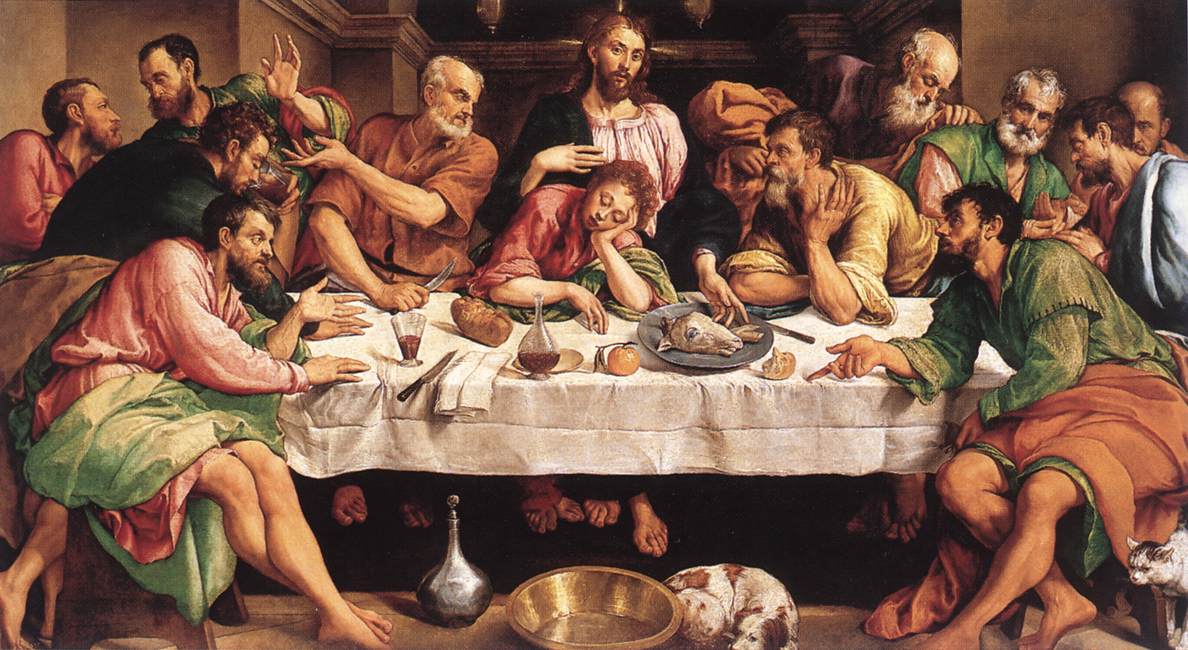 For those who haven't seen it yet, the latest edition of US News and World Report claims to be "In Search of the Real Jesus" on the cover. Of course why try the novel approach of searching the scriptures, right? Alright, forgive my sarcastic pessimism but since the Da Vinci Code (both book and movie) and National Geographics marketing of the Gospel of Judas (Ehrman probably deserves honarable mention in such a list too), the popularization of alternative christianities has become almost naseuating in the mainstream media. It's not as if these things are cutting edge issues that have never been considered before in the history of Christiainity. Furthermore, some of the extremes (I have Dan Brown in mind here) don't even deserve the attention they've earned. Though I was silent in the blogosphere back when The Davinci Code was the hot button, suffice it to say I haven't seen the movie yet. Not due to conscience, but due more to the fact that it got terrible reviews. Since I did read the book (at least the half I could stomach) and concluded without finishing that it sucked (historically, theologically and as most of all masquerading as work of literature), I saw little need of seeing a movie that even those who liked the book disdained.
 Anyway, this rant is sourced in the ridiculously slanted piece of so called journalism in the aforementioned latest edition of USNWR. While this periodical is typically fairly conservative politically (at least relatively speaking), they apparently could use a new religion editor. The article is punctuated with slanted phrases like "In that struggle -- arguably the most improtant waged by self-styled correct believers againt the so-called-heretics," "soldiers of orthodoxy," "the prominent second century hersy hunter, Bishop Irenaeus" and a picture of NT Wright in full clerical garb and an somber expression that makes him look a morbid misanthrope (or perhaps the 20th century heir to Irenaeus, the heresy hunter).
To be fair, I still need to finish the article, though I've already skimmed the remainder of it. However, the opening few pages had me so heated, I thought I'd vent a few words online. These issues have been on my front burner in recent days as I've been reading through Jesus and the Victory of God and am anticipating dipping into Bauckham's most recent treatise soon. Furthermore, due to a recent rebuke from reading Euangelion, I've been wading my way through some of the apocryphal and gnostic literature (Tobit, 1 Maccabeas and the Gospel of Thomas in the last few days). Anyway, all of this has put me in the frame of mind to want to gag while reading this sort of yellow journalism parading itself in the name of objective reporting. Instead, the article is guilty of the very sort of ideological imperalism that it accuses early orthodox christianity of. Nevertheless, it affirms the necessity of familiarizing oneself with the extra-canonical (if you'll excuse such a subversive, repressive term) literature. These issues are becoming more and more common in mainstream media and it is only fitting that believers have an informed answer.
**Postscript - I finished the article and it ends with more substance than it begins. There are some good quotes from Wright and Luke Timothy Johnson. However, the conclusion does not salvage the first half in such a way to make me retract anything I've said above.
Friday, December 08, 2006
Letters Along the Way
I recently received a voicemail from a college guy I've been "discipling" with questions regarding the issue of Predestination. While I did not go into the depths of exegetical/theological wrestling, I thought it was an interesting enough discussion to post here and see who I could get riled up. I thought it better to respond, rather than a 30 second voicemail, with an email that I've included the text of below:
I thougth it may be easier and more helpful to respond to you via email. I hope all is going well, and look forward to seeing you in a week or two!
Regarding the "election" of the unsaved:
This is a VERY touchy area theologically. My view is different from most at CBTS, but I'll describe both. The question is essentially "Does God elect people to damnation in the same way that He elects people to salvation." I say "yes" but be advised I'm in a SMALL minority. Most, even the most Calvinists say "no."
Those who say no, even the calvinists typically describe this topic (commonly referred to as reprobation) in terms of God "passing over" those He hasn't elected. In other words, some He chooses to salvation and this is CLEAR from Scripture (remember Ephesians 1?). The rest, He simply doesn't choose...that is, He leaves them to go their own way, in there depravity. Without His intervention, they naturally don't choose Him (Rom 1:18, 3:11) and thus spend an eternity under His condemnation. Since scripture does NOT explicitly say that He elects them to damnation, this option supposedly provides what theologians refer to as a theodicy, that is a justification or vindication of God. I infer (perhaps they imply) that it would be morally wrong, or evil of God to elect people to damnation; entirely capricious. Since it is all of grace that He chooses ANY to salvation, He is not compelled to choose all; hence those He doesn't choose, will never choose Him.
The problem I have here is that I'm not convinced this "vindicates" God (as if we had to). [Editorial note - My wife's somewhat less theologically nuanced, though equally satisfying response to this argument was: "That's stupid! It doens't solve anything."] If He COULD have done something and He DIDN'T, I don't see how this makes Him anymore benevolent or less capricious. Furthermore, I think there are at least two scripture passages that have direct bearing here:
Romans 9:17-23 For the Scripture says to Pharaoh, "For this very purpose I raised you up, to demonstrate My power in you, and that My name might be proclaimed throughout the whole earth." 18 So then He has mercy on whom He desires, and He hardens whom He desires.....22What if God, although willing to demonstrate His wrath and to make His power known, endured with much patience vessels of wrath prepared for destruction? 23 And He did so in order that He might make known the riches of His glory upon vessels of mercy, which He prepared beforehand for glory...
1 Peter 2:6-8 For this is contained in Scripture: "Behold I lay in Zion a choice stone, a precious corner stone, And he who believes in Him shall not be disappointed." 7 This precious value, then, is for you who believe. But for those who disbelieve, "The stone which the builders rejected, This became the very corner stone," 8 and, "A stone of stumbling and a rock of offense"; for they stumble because they are disobedient to the word, and to this doom they were also appointed.
These verses are pivotal for me. I emboldened the most significant phrases, but in the larger context, they are even that much more persuasive. To be sure, others don't ignore these texts and would offer up alternate interpretations or ways of getting around them. Bottome line: you must wrestle with the texts and correlate them into your understanding of the doctrine of God. The reason why it's such a touchy issue is because of what some people infer (which is different from imply) from this doctrine. Many think to come to the conclusion that I do is to impune God with with evil actions or motives. However, it comes back to your understanding of sovereignty (which is a worldview shaping doctrine). Here's a quote from Karl Barth that I recently posted on my blog (be forewarned though, quoting Barth at [his college] won't do much but get you in more trouble :-)
"From the act of atonement that has taken place in Jesus Christ, it is clear that in evil we do not have to do with a reality and power which have escaped the will and work of God, let alone with something that is sovereign and superior in relation to it. Whatever evil is, God is it's Lord."
That last statement in bold is fantastic and thoroughly biblical. I grant you this is a short and perhaps slanted response, but that's the nature of email. Let me know if you have more questions or if there are other texts in particular that you're wrestling with. Of course none of this rules out moral responsibility. Yes we do make genuine choices that have eternal consequences, but NONE of this is outside of the sovereign control of God. "Whosoever will may come?" Yes. But be sure to balance it with "No one comes unless the Father draws them" (John 6:44). There is a tension to be sure, but who ever said theology was easy? :-)
- Nate
PS, I think I'm going to post a copy of this on my blog, if you don't mind. You've raised an excellent question that I think is worth wrestling with in a public context.
I thougth it may be easier and more helpful to respond to you via email. I hope all is going well, and look forward to seeing you in a week or two!
Regarding the "election" of the unsaved:
This is a VERY touchy area theologically. My view is different from most at CBTS, but I'll describe both. The question is essentially "Does God elect people to damnation in the same way that He elects people to salvation." I say "yes" but be advised I'm in a SMALL minority. Most, even the most Calvinists say "no."
Those who say no, even the calvinists typically describe this topic (commonly referred to as reprobation) in terms of God "passing over" those He hasn't elected. In other words, some He chooses to salvation and this is CLEAR from Scripture (remember Ephesians 1?). The rest, He simply doesn't choose...that is, He leaves them to go their own way, in there depravity. Without His intervention, they naturally don't choose Him (Rom 1:18, 3:11) and thus spend an eternity under His condemnation. Since scripture does NOT explicitly say that He elects them to damnation, this option supposedly provides what theologians refer to as a theodicy, that is a justification or vindication of God. I infer (perhaps they imply) that it would be morally wrong, or evil of God to elect people to damnation; entirely capricious. Since it is all of grace that He chooses ANY to salvation, He is not compelled to choose all; hence those He doesn't choose, will never choose Him.
The problem I have here is that I'm not convinced this "vindicates" God (as if we had to). [Editorial note - My wife's somewhat less theologically nuanced, though equally satisfying response to this argument was: "That's stupid! It doens't solve anything."] If He COULD have done something and He DIDN'T, I don't see how this makes Him anymore benevolent or less capricious. Furthermore, I think there are at least two scripture passages that have direct bearing here:
Romans 9:17-23 For the Scripture says to Pharaoh, "For this very purpose I raised you up, to demonstrate My power in you, and that My name might be proclaimed throughout the whole earth." 18 So then He has mercy on whom He desires, and He hardens whom He desires.....22What if God, although willing to demonstrate His wrath and to make His power known, endured with much patience vessels of wrath prepared for destruction? 23 And He did so in order that He might make known the riches of His glory upon vessels of mercy, which He prepared beforehand for glory...
1 Peter 2:6-8 For this is contained in Scripture: "Behold I lay in Zion a choice stone, a precious corner stone, And he who believes in Him shall not be disappointed." 7 This precious value, then, is for you who believe. But for those who disbelieve, "The stone which the builders rejected, This became the very corner stone," 8 and, "A stone of stumbling and a rock of offense"; for they stumble because they are disobedient to the word, and to this doom they were also appointed.
These verses are pivotal for me. I emboldened the most significant phrases, but in the larger context, they are even that much more persuasive. To be sure, others don't ignore these texts and would offer up alternate interpretations or ways of getting around them. Bottome line: you must wrestle with the texts and correlate them into your understanding of the doctrine of God. The reason why it's such a touchy issue is because of what some people infer (which is different from imply) from this doctrine. Many think to come to the conclusion that I do is to impune God with with evil actions or motives. However, it comes back to your understanding of sovereignty (which is a worldview shaping doctrine). Here's a quote from Karl Barth that I recently posted on my blog (be forewarned though, quoting Barth at [his college] won't do much but get you in more trouble :-)
"From the act of atonement that has taken place in Jesus Christ, it is clear that in evil we do not have to do with a reality and power which have escaped the will and work of God, let alone with something that is sovereign and superior in relation to it. Whatever evil is, God is it's Lord."
That last statement in bold is fantastic and thoroughly biblical. I grant you this is a short and perhaps slanted response, but that's the nature of email. Let me know if you have more questions or if there are other texts in particular that you're wrestling with. Of course none of this rules out moral responsibility. Yes we do make genuine choices that have eternal consequences, but NONE of this is outside of the sovereign control of God. "Whosoever will may come?" Yes. But be sure to balance it with "No one comes unless the Father draws them" (John 6:44). There is a tension to be sure, but who ever said theology was easy? :-)
- Nate
PS, I think I'm going to post a copy of this on my blog, if you don't mind. You've raised an excellent question that I think is worth wrestling with in a public context.
Tuesday, November 28, 2006
Symbolic Suggestions
While this doesn't quite parallel the poll I took on our family blog, I would like some input from any of the regular readers of this blog. If I were to get a tattoo (wow, I never thought I'd start a sentence that way :-) I'm convinced of what I'd want it to say:
Post Tenebras Lux
Translated from Latin, the phrase means "after darkness, light" and was one of the battle cries of the Reformation (and there would probably be a little double entendre if it were to be scripted on my arm). Google it if you want to see more. The problem? I don't think I just want a script. So I'm looking for some good ideas for a symbol to put it on or with. Think in terms off it being on a shoulder. I've surfed the web for some ideas and come up wanting. A cross is about the only offering and unless it was a decent graphic, crosses may be overdone. So, any ideas?
Post Tenebras Lux
Translated from Latin, the phrase means "after darkness, light" and was one of the battle cries of the Reformation (and there would probably be a little double entendre if it were to be scripted on my arm). Google it if you want to see more. The problem? I don't think I just want a script. So I'm looking for some good ideas for a symbol to put it on or with. Think in terms off it being on a shoulder. I've surfed the web for some ideas and come up wanting. A cross is about the only offering and unless it was a decent graphic, crosses may be overdone. So, any ideas?
Friday, November 24, 2006
The Way I See It # 95
Now that Barker has liberated my conscience, I'm back to blogging :-) (See the previous post's comment section if you don't know what I'm referring to) I have a few quotes off of Starbucks' cups that I was wanting to blog on. Since we're into the X-mas season, there probably won't be too many more for a while. Furthermore, GOOD quotes on Starbucks cups are few and far between. Nevertheless, I think #95 was pretty interesting if you allow me a few reader-response tweaks and adjustments.
"Our species survival depends on how fast we embrace the moral shift from 'patriot' to 'global citizen.'" - Chris Anderson, creator of TED a conference of leading thinkers in technology, entertainment and design.
The "tweaks" are probably fairly obvious: I'm not too concerned about the survival of our species. But if you were to christianize the thought - that is, sift it through a christian worldview - I would posit it something like: "Our stewardship of the Gospel demands we embrace the moral (or perhaps cultural) shift from patriot to global citizen. " In other words, the world around us is rapidly making such paradigmatic shifts, of course largely as a result of technology. Sadly, too many believers have confused Christianity with Americanism and resist such shifts. The result is that much of the American church is behind this shift, rather than leading on the cutting edge of it. After all, Christianity is NOT about baseball, the fourth of July and apple pie. Sure, America is a GREAT place to live; but as believers we should have long ago recognized our place as global citizens. Our citizenship is not of this world, but to be sure we will inherit the earth. Thus, we ought to be global citizens in the truest sense of the word. After all:
"And they sang a new song: "You are worthy to take the scroll and to open its seals, because you were slain, and with your blood you purchased men for God from every tribe and language and people and nation. You have made them to be a kingdom and priests to serve our God, and they will reign on the earth." -Revelation 5:9-10
 section if you don't know what I'm referring to) I have a few quotes off of Starbucks' cups that I was wanting to blog on. Since we're into the X-mas season, there probably won't be too many more for a while. Furthermore, GOOD quotes on Starbucks cups are few and far between. Nevertheless, I think #95 was pretty interesting if you allow me a few reader-response tweaks and adjustments.
"Our species survival depends on how fast we embrace the moral shift from 'patriot' to 'global citizen.'" - Chris Anderson, creator of TED a conference of leading thinkers in technology, entertainment and design.
The "tweaks" are probably fairly obvious: I'm not too concerned about the survival of our species. But if you were to christianize the thought - that is, sift it through a christian worldview - I would posit it something like: "Our stewardship of the Gospel demands we embrace the moral (or perhaps cultural) shift from patriot to global citizen. " In other words, the world around us is rapidly making such paradigmatic shifts, of course largely as a result of technology. Sadly, too many believers have confused Christianity with Americanism and resist such shifts. The result is that much of the American church is behind this shift, rather than leading on the cutting edge of it. After all, Christianity is NOT about baseball, the fourth of July and apple pie. Sure, America is a GREAT place to live; but as believers we should have long ago recognized our place as global citizens. Our citizenship is not of this world, but to be sure we will inherit the earth. Thus, we ought to be global citizens in the truest sense of the word. After all:
"And they sang a new song: "You are worthy to take the scroll and to open its seals, because you were slain, and with your blood you purchased men for God from every tribe and language and people and nation. You have made them to be a kingdom and priests to serve our God, and they will reign on the earth." -Revelation 5:9-10
Saturday, November 18, 2006
Getting it Wright from an Early Age
Okay, I think I've established the point that it's virtually impossible for me to bring up Tom Wright on this blog without a junior highishly overdone pun...nevertheless, that's part of who I am :-) I thought I'd demonstrate just how seriously I take the responsibility of parenting by posting a picture of me recently reading Noah a "bedtime story." As you can see this young scholar in training is far more engrossed in the current volume than his post-grad dad.
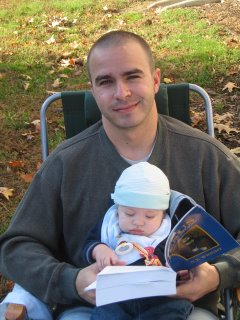
However, don't let his apparent interest deceive you; he only sat still long enough for me to read him about a page and a half. After that his attention could only be maintained through other means...

I've been out of the blogosphere for a little over a week due to internet problems (those dang neighbors need to upgrade their connection). Things seem to be back on course now, and I should be back to regular blogging (whatever that is) soon.

However, don't let his apparent interest deceive you; he only sat still long enough for me to read him about a page and a half. After that his attention could only be maintained through other means...

I've been out of the blogosphere for a little over a week due to internet problems (those dang neighbors need to upgrade their connection). Things seem to be back on course now, and I should be back to regular blogging (whatever that is) soon.

Wednesday, November 08, 2006
Woman may not preach, but they sure can blog!
I thought I'd give a shout out to my wife and do a little shameless advertisement for our family blog. Dawn has posted her first "substantive" post with some expositional thoughts on Phil 4 and worry here. She doesn't consider herself much of a writer, but I think she's got some great reflections on the text. Be sure to check out the pics too...we've got some shots of Noah's contribution for election day.
Tuesday, November 07, 2006
Barth on Evil
 Since several who are also reading up on Barth right now have already posted, I felt compelled by the peer pressure to toss in my two cents. Ok, so that's not exactly the case but I thought I would pass on a quote or two that particularly stood out. I've been reading John Webster's introduction Barth: Outstanding Christian Thinkers (recommended by Barth fan Ben Myers on the reading list on his blog) and am just about finished (I know, I know... finally I've finished something other than Driscoll and Clancy). The book is pictured at the right and despite the fact that the latest cover makes it look like a kid's book, it's been a good read. Don't misunderstand me, I don't claim to understand all that Webster's saying (let alone what Barth says) but it has served as a helpful intro in view of my lacuna with reference to neo-orthodoxy. Regardless of what you may think of Barth, he definitely has some great things to say at times. I liken Barth to a Glock pistol. For the non-shooters out there, glocks are double-action only and have a 5.5lb trigger pull. The result is that most people shoot them and either love them or hate them; there's no in between. Likewise with Barth (at least for me so far)...you read something he's said and either love it or hate it. Granted, on occasion, there may be an additional category (i.e. you just don't plain understand it), but I think the comparison fits. Anyway, Barth seems to be the only person I'm aware of that places a greater emphasis on Freedom and Sovereignty that Scott Logan (perhaps there's a connection there somewhere :-0) and I find it quite refreshing. I thought the following words on the problem of evil were excellent:
 "From the act of atonement that has taken place in Jesus Christ, it is clear that in evil we do not have to do with a reality and power which have escaped the will and work of God, let alone with something that is sovereign and superior in relation to it. Whatever evil is, God is it's Lord."
- (IV/1 p. 408 as cited in Webster, Barth, p. 125)
I LOVE IT!!! however, you want to define evil, metaphysically or ontologically or however else you want of speak of it...whatever else you want to say about the the nature and existence of evil in this world -- it does not, cannot escape the dominion of Jesus. God IS it's Lord!
Sunday, October 29, 2006
Unbelieveable Resource
Check out this site for some incredible online resources. Access is free until the end of the year and a nominal fee will be charged for those who can afford it after that point. If you're tempted to ignore my suggestion and NOT click on the link, let me give you just a teaser but pointing out you can access the full text to the volumes of the Word Commentary series free. It shouldn't take much more than that...
(HT: Dave Griffiths)
(HT: Dave Griffiths)
Subscribe to:
Posts (Atom)